
How to Back Up All Google Photos: 5 Safe Ways
If you want to backup all photos from Google Photos, you may find the solution on this page. We conclude the detailed steps to get it.

by Richard Lasted Updated August 28, 2026


To back up your entire Google Photos library, use Google Takeout, select only Google Photos, choose your archive settings, and download every archive part when Google emails you. For a small selection, open the Google Photos website, select the items, and choose Download. Keep at least two verified copies if the photos matter to you.
Which Google Photos Backup Method Should You Use?
| Your goal | Best method | Main limitation |
|---|---|---|
| Download the whole library to a computer or external drive | Google Takeout export | Large libraries arrive in multiple archives and need verification |
| Save a few photos or one album | Download photos from Google Photos | Manual selection is inefficient for a large library |
| Copy the library to a supported cloud service | Google Takeout direct transfer | Destinations vary by country and account; duplicates are possible |
| Keep an ongoing copy in another Google Account | Partner Sharing with auto-save | It is account-to-account sharing, not an offline backup |
| Protect a downloaded export automatically | Back up the Takeout folder with CBackup | Requires enough destination-cloud space |
For most people, the safest answer is a Google Takeout export saved on a computer or external drive, followed by a second copy in another location. This follows the practical 3-2-1 backup rule: three copies of important data, on two types of storage, with one copy kept off-site.
How to Back Up All Google Photos with Google Takeout
Google Takeout is Google’s official bulk-export tool. It can export your photos and videos by album or year and is the most practical choice when you want a local copy of the entire library.
Step 1. Go to Google Takeout and sign in to the Google Account that contains the library.
Step 2. Click Deselect all, scroll to Google Photos, and check its box. Select All photo albums included if you want to exclude particular albums or years.
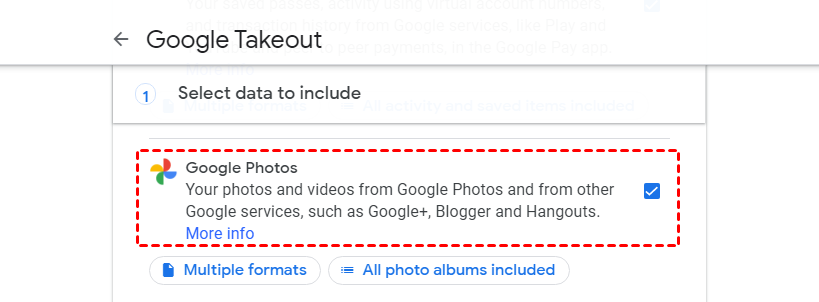
Step 3. Click Next step. For delivery, choose an email download link or one of the cloud destinations currently offered for your account.
Step 4. Choose Export once for a one-time backup. Select ZIP for the widest compatibility. Pick an archive size your computer and file system can handle; Google splits larger exports into several files automatically.
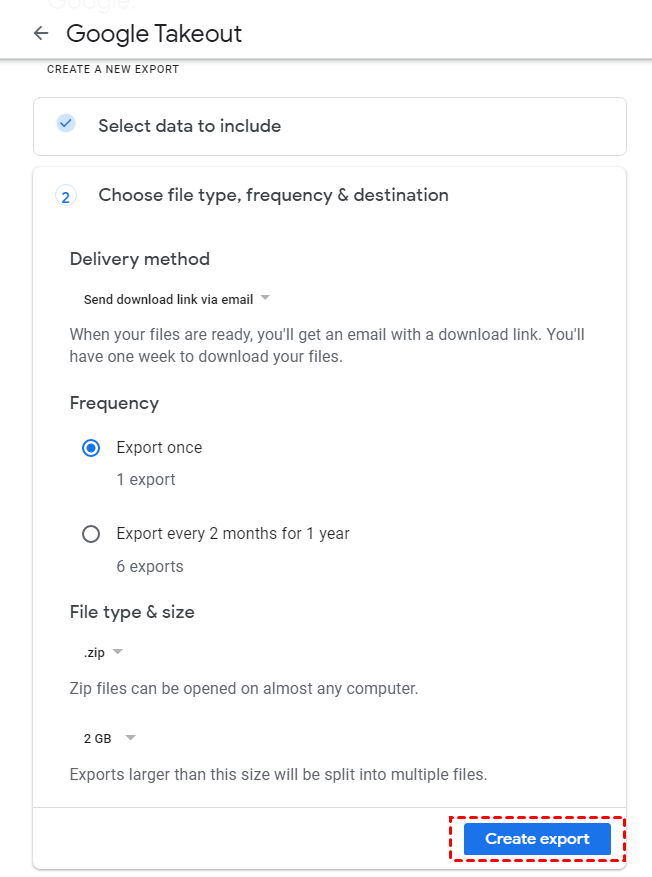
Step 5. Click Create export. Google may take from minutes to days to prepare a large library. When the notification arrives, download every archive part before the links expire.
Step 6. Extract the archives into one clearly named folder. Open photos and videos from the beginning, middle, and end of the date range. Compare the exported years or albums with Google Photos before treating the job as complete.
How Often Should You Export Google Photos?
A one-time export is only a snapshot. If your library changes regularly, create a new export on a schedule that matches how often you take important photos, monthly, quarterly, or at least after a major event. Google Takeout may offer recurring exports, but you should still verify each delivery and copy it to durable storage.
How to Download Selected Photos or An Album
For a few items, downloading from the Google Photos website is faster than creating a full Takeout archive.
Step 1. Open Google Photos in a desktop browser and check the account shown in the upper-right corner.
Step 2. Hover over a photo and click its checkmark. To select a continuous range, select the first item, hold Shift, and select the last item.
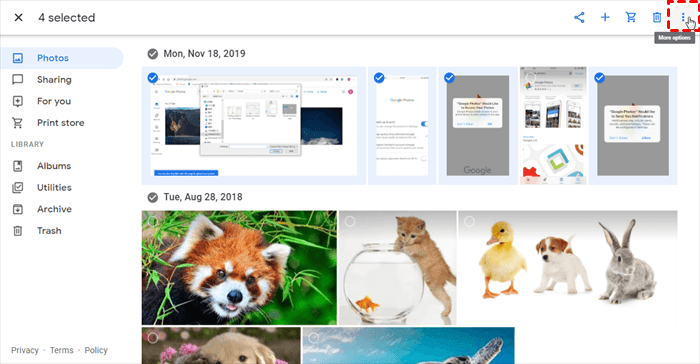
Step 3. Open the three-dot menu and choose Download. Multiple selected items are normally packaged as a ZIP file.
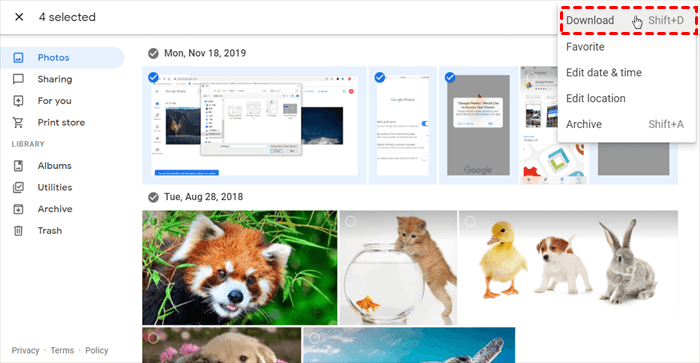
To download an album, open the album, select the three-dot menu, and choose Download all. If an item is already stored on the device, the Download option may not appear in the mobile app.
How to Copy Google Photos Directly to Another Cloud
Google can transfer a copy of supported photos, videos, albums, and descriptions to certain external services through Takeout. The destinations available to you depend on your region, account type, and Google’s current integrations.
Step 1. Open Google’s transfer a copy page and choose the Google Photos data you want to copy.
Step 2. Select an available destination, like moving Google Photos to OneDrive, sign in to that service, and review the access request carefully.
Step 3. Start the transfer and wait for the completion email. Then inspect the destination and compare several albums, file types, and dates with the source library.
- The transfer does not delete the originals from Google Photos.
- The destination needs enough free space.
- Unsupported formats may not transfer.
- Running the transfer again can create duplicate copies.
- Some albums or files may appear in different folders at the destination.
If the cloud provider you want is not offered, first export with Google Takeout, then upload or back up the extracted folder to that provider. This adds a local recovery copy and makes the transfer easier to audit.
Can Partner Sharing Back Up Google Photos to Another Account?
Partner Sharing can copy photos to one other Google Account. In Google Photos, open Settings > Sharing > Partner Sharing, choose the photos to share, and send the invitation. In the receiving account, accept it and set Save to your account to All photos.
This is useful for account migration or convenient redundancy, but it should not be your only backup. Both libraries remain inside the Google ecosystem, and storage behavior can change when sharing ends or the source item is deleted. For disaster recovery, also keep an offline or independently managed copy.
Back Up Your Google Photos Export with CBackup
After Google Takeout has downloaded the library to your Windows PC, CBackup can back up that local export folder to a supported cloud drive. This does not connect CBackup directly to Google Photos, but it protects the files you have already exported.
Step 1. Extract every Takeout archive into a dedicated folder. Keep the JSON sidecar files with their matching photos.
Step 2. Download and install CBackup, then sign in.
Step 3. Add and authorize the cloud storage account you want to use. Grant only the permissions needed for the backup.

Step 4. Create a PC-to-cloud backup task, select the extracted Google Photos folder as the source, and select your cloud drive as the destination.
Step 5. Start the backup. If you will repeat Takeout exports, set a schedule and use a consistent folder structure so new files are easy to find and verify.
CBackup seems to be the best way to back up Google Photos, because it also lets you combine available capacity from multiple supported cloud-drive accounts into one Combined Cloud. This can be helpful when a Takeout export is larger than the free space in a single account, although each underlying account remains subject to its provider’s quota and terms.
How to Verify a Google Photos Backup
A completed download notification is not proof that every memory is recoverable. Before deleting photos or cancelling storage, run these checks:
- Confirm all archive parts: make sure no numbered ZIP or TGZ file is missing.
- Test extraction: an archive that cannot be extracted may be incomplete or corrupt.
- Sample every period: open files from several years, albums, and devices.
- Test videos and special formats: include long videos, RAW photos, HEIC files, motion photos, and edited images if you use them.
- Check metadata: retain JSON sidecars and confirm that important capture dates display correctly.
- Make a second copy: copy the verified export to an external drive or a separately secured cloud account.
- Protect the account: use a strong unique password and multi-factor authentication for any cloud destination.
Common Questions About Backing Up Google Photos
Does Google Photos back up to Google Drive automatically?
No. Google Photos and Google Drive no longer automatically sync photos with each other. If you want a Drive copy, export the library and upload it, or use a currently supported transfer workflow.
Will Google Takeout delete my photos?
No. Takeout creates an export. Your Google Photos library remains unchanged unless you separately delete items.
Can I download all Google Photos in one click?
You can request the whole library in one Takeout export, but a large export is usually divided into multiple archive files. Download and verify every part.
Why are there duplicate photos in my Takeout export?
The same photo can be represented in multiple album folders, and a repeated export or transfer can create another copy. Do not remove duplicates until you have compared file content, dates, and metadata.
Does copying photos to another cloud free Google storage?
No. A copy or transfer leaves the originals in Google Photos. Storage is freed only after eligible originals are deleted, Trash is emptied, and you should do that only after verifying the backup.
What is the safest backup setup?
Keep the Google Photos library, one verified copy on a computer or external drive, and one copy in a separate cloud location. Encrypt portable drives that may be lost or stolen.
Conclusion
Use Google Takeout when you need a complete Google Photos backup and the Google Photos website when you need only a few items or one album. A direct cloud transfer is convenient, but it still needs verification and does not replace an independent copy. Once the export is checked, protect it on an external drive or back up the folder to another cloud with CBackup.
Secure & Free