Which Is the Best 500GB Free Cloud Storage: 6 Best Options (2026)
To get 500 GB of free cloud storage, here are the top 6 best cloud services in this post. Find the most suitable cloud storage services for you, and you can follow the tutorials below to gain free unlimited cloud storage for a lifetime effortlessly.

by Richard Lasted Updated August 25, 2026


If you are looking for 500GB of free cloud storage in a single account, the short answer is no. Mainstream providers generally give new users between 5GB and 20GB of free data. Getting all the way to 500GB means either paying for a larger plan or making better use of storage you already have across several cloud accounts.
- Important:
- A Combined Cloud does not turn separate accounts into one provider account or remove their limits. Its capacity is the sum of the available quotas in the accounts you connect. Each account remains subject to its provider's terms, inactivity rules, and storage limits.
Can You Get 500GB of Cloud Storage for Free?
Not from a single mainstream provider as a permanent, no-strings-attached free plan. Offers claiming “500GB free” may be temporary promotions, referral bonuses, limited trials, or services with inactivity and transfer restrictions. Check the provider's current terms before uploading important files.
In practice, people reach that amount of storage in one of the following ways:
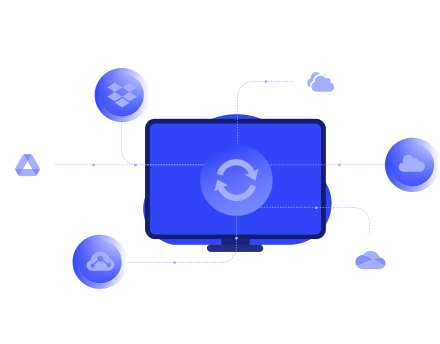
- Combine storage you already own: Connect supported Google Drive, OneDrive, and Dropbox accounts to CBackup and use their available quotas as one backup destination.
- Buy a 500GB plan: This is the simplest option when you want one account, predictable support, and fewer management limits.
- Use a lifetime plan: Some providers sell 500GB for a one-time payment, but “lifetime” means the service's lifetime and remains subject to its terms.
Best Free Cloud Storage Options Compared
The table below focuses on permanent base storage advertised by established providers. Temporary bonuses are excluded because they can expire. Plan details can change, and availability may vary by region, so verify the provider's plan page before signing up.
| Cloud service | Free storage | Best for | Main limitation |
|---|---|---|---|
| MEGA | 20GB | Privacy-focused file storage and sharing | Transfer limits apply; keep the recovery key safe |
| Google Drive | Up to 15GB | Google Docs, Gmail, and Photos users | Quota is shared across Drive, Gmail, and Photos |
| pCloud | Up to 10GB | Cross-platform file access and sharing | Some capacity may require account setup tasks |
| Box | 10GB | File sharing and lightweight collaboration | Free Individual plan has a 250MB upload limit per file |
| Icedrive | 10GB | Simple storage and media previews | Some advanced security and sharing tools require payment |
| CBackup Cloud | 10GB | Windows PC backup | Inactive-account and data-retention rules apply |
One account from every service in the table would provide no more than 75GB based on the advertised quotas. That can cover documents and a modest backup, but it falls well short of a 500GB photo, video, or device library. At that size, a paid plan is often the simpler option.
1. MEGA: 20GB Free
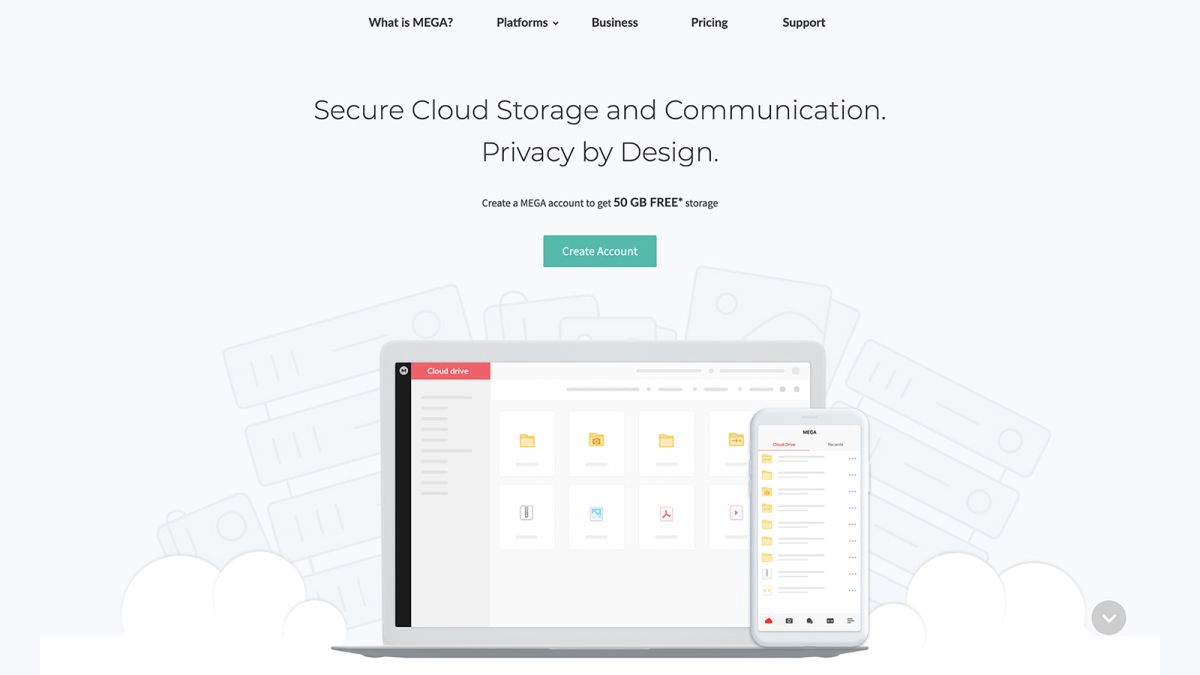
MEGA advertises 20GB of free encrypted cloud storage. It offers desktop and mobile apps, file sharing, version history, and client-side encryption. Unlike the old 50GB introductory offer sometimes quoted online, the current base free allocation is 20GB. Achievement or promotional bonuses should not be treated as permanent capacity.
Among the services listed here, MEGA is worth considering when privacy features and a relatively generous free allowance matter most. Keep its recovery key somewhere safe, though. If you lose both the key and your password, you may not be able to recover your files.
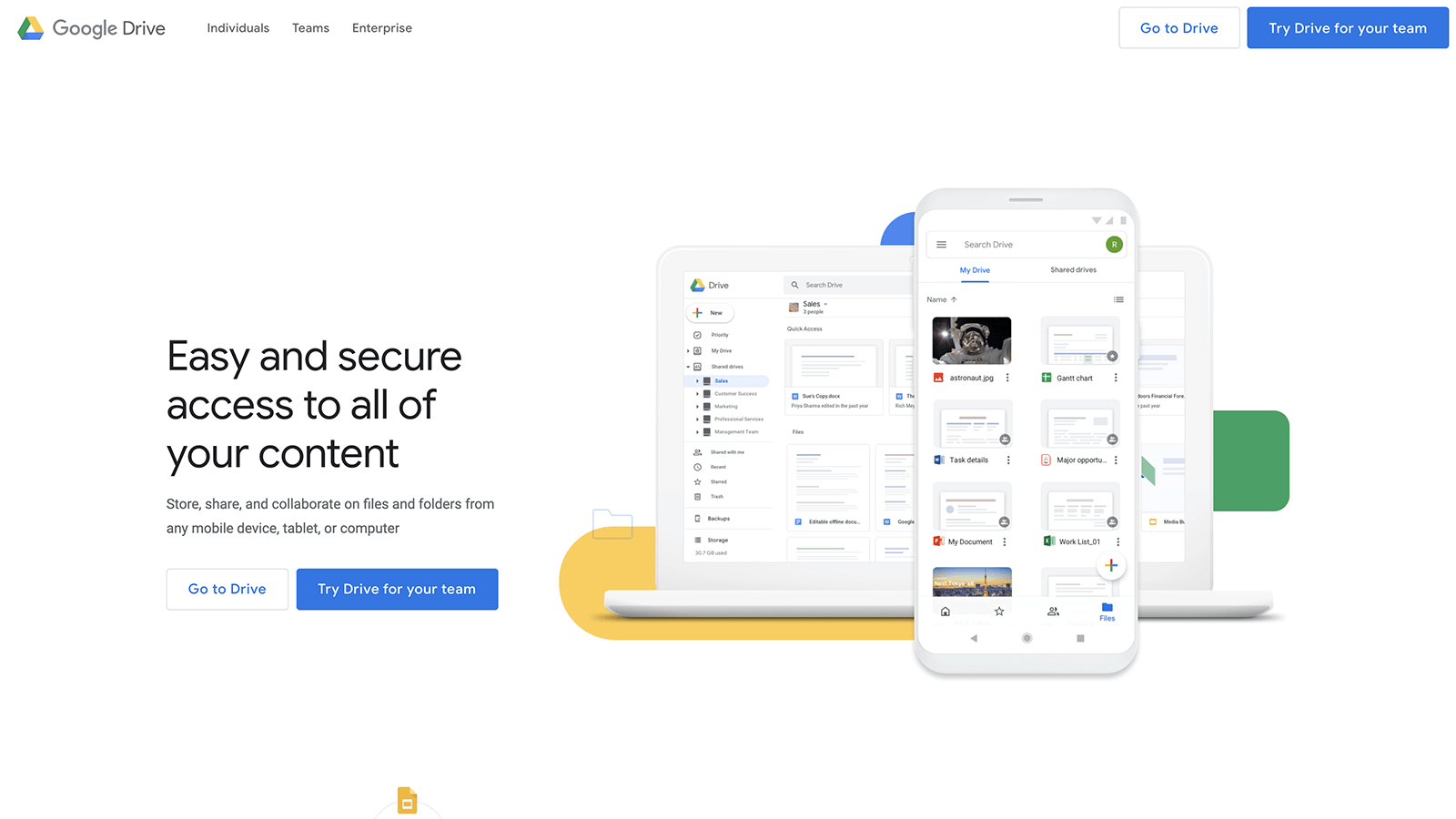
2. Google Drive: Up to 15GB Free
Google Drive is a convenient choice for people who use Google Docs, Sheets, Gmail, and Google Photos. A Google Account can include up to 15GB at no charge, but that space is shared across Drive, Gmail, and Photos. A full Gmail mailbox or photo library therefore reduces the amount available for Drive files.
The appeal of Google Drive is not simply its free quota. It works especially well for shared documents and for people already using Google's other services. Before buying more space, check the Google storage manager; old email attachments or unnecessary photos may be using more of the shared allowance than expected.
3. pCloud: Up to 10GB Free
pCloud advertises up to 10GB of free storage with no credit card required. It supports file access, sharing, automatic mobile uploads, and desktop apps. Some of the free capacity may need to be unlocked by completing account setup steps.
For someone who moves between a phone, browser, and desktop, pCloud is an easy service to fit into an existing routine. It also offers one-time-purchase plans for users who later need more capacity. Its optional client-side encryption is separate from the basic free account, so do not assume every advertised security feature is included at no cost.
4. Box: 10GB Free
Box provides 10GB on its free Individual plan. Its sharing links, integrations, e-signature tools, and collaboration features can be useful for documents and small work files.
Box makes more sense for documents and lightweight collaboration than for large personal archives. The 250MB upload limit on its free Individual plan is enough for most office files, but restrictive for videos, disk images, and full-device backups.
5. Icedrive: 10GB Free
Icedrive lists 10GB on its free plan. It supports browser, desktop, and mobile access and can preview common document and media formats. Its Windows virtual drive can make cloud files feel more like files on an attached drive.
Its clean interface and Windows virtual drive are the main attractions. Icedrive is less compelling if advanced sharing controls or encryption features are essential, since some of those tools are limited to paid plans.
6. CBackup Cloud: 10GB Free
CBackup provides 10GB of CBackup Cloud space for Windows PC backup. It can back up selected files to CBackup Cloud or supported public clouds and restore backed-up data when needed. Free-account data is subject to CBackup's current retention and inactivity policy, so check the policy and sign in periodically.
CBackup also supports cloud-to-cloud backup and can build a Combined Cloud from supported Google Drive, OneDrive, and Dropbox accounts. Instead of switching between several dashboards, you can manage their available capacity as a backup destination from one place.
How to Combine Cloud Storage with CBackup
If you already own and are permitted to use multiple supported cloud accounts, CBackup can present their available storage as a single Combined Cloud for backup tasks. This reduces account switching and lets you expand the destination later by adding eligible storage.
Example: Two Google Accounts with 15GB available each, one OneDrive account with 5GB, and one Dropbox account with 2GB provide up to 37GB of combined capacity. To reach 500GB, the connected accounts must collectively have at least 500GB available. CBackup does not create the missing capacity.
Step 1. Download and install CBackup, then create a CBackup account and sign in.
Step 2. Open Storage, select Google Drive, OneDrive, or Dropbox, and click Authorize Now. Complete the provider's authorization process. Repeat for each account you own and can connect.
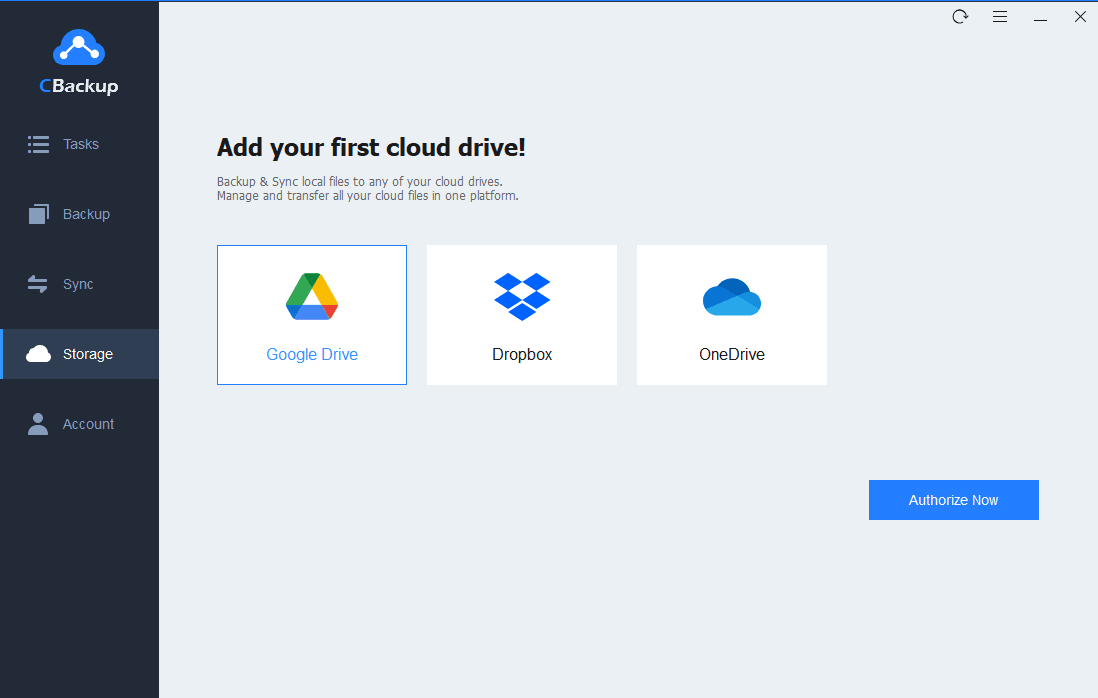
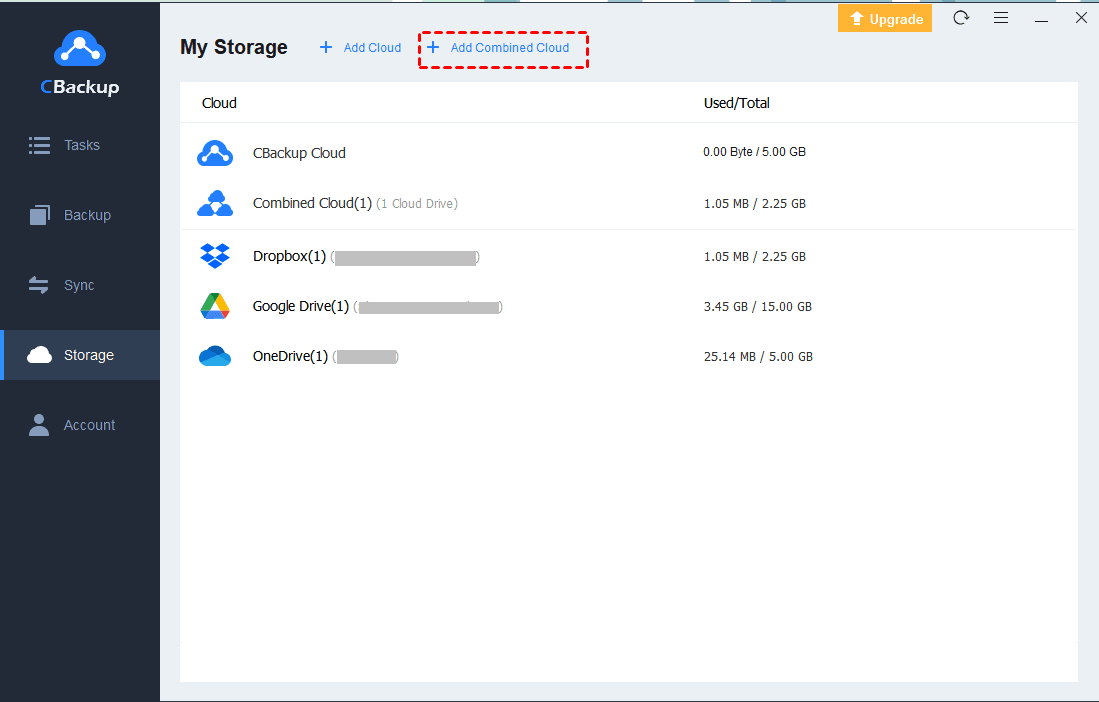
Step 3. Go to Storage and select Add Combined Cloud.
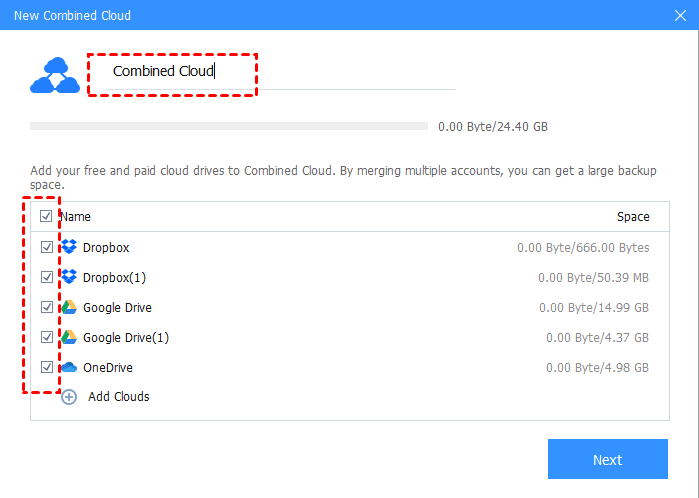
Step 4. Enter a display name, select the connected cloud accounts, click Next, and then click Combine.
- ★Tip:
- Use only accounts you own or are authorized to manage. Creating accounts solely to evade a provider's limits may violate its terms. For important data, keep another independent copy—the 3-2-1 backup rule recommends three copies, on two types of storage, with one copy off-site.
Is Free or Paid 500GB Storage Better?
| Need | Better choice | Why |
|---|---|---|
| Occasional document backup | Free tiers | No subscription may be needed for a small data set |
| Use existing space across several clouds | CBackup Combined Cloud | Centralizes supported capacity for backup management |
| Store about 500GB in one place | Paid 500GB or larger plan | Simpler billing, support, sharing, and quota management |
| Keep irreplaceable photos or work files | Multiple independent backups | One cloud account should not be the only copy |
Frequently Asked Questions
Which cloud service gives 500GB free?
None of the established providers compared here gives every new user 500GB permanently at no charge. If you see such an offer, first find out whether it is a trial or referral bonus and what happens after the promotion ends.
Can I combine free cloud accounts to get 500GB?
Yes, provided the supported accounts already contain that much available capacity. CBackup can organize the space as a Combined Cloud, but it cannot multiply the quotas or override the rules of Google Drive, OneDrive, or Dropbox.
Is combined cloud storage truly unlimited?
No. “Combined” describes how the accounts are managed, not an infinite supply of storage. The usable total rises or falls with the available capacity of the connected accounts.
What is the largest free cloud storage in this comparison?
MEGA leads this particular comparison with a 20GB base free allocation. Google Drive follows with up to 15GB; the other four services listed provide 10GB or up to 10GB.
Is lifetime cloud storage really permanent?
Not in the literal sense many buyers expect. “Lifetime” normally refers to the service and the conditions in its contract, rather than a guarantee that storage will remain available for the rest of the buyer's life. Check the refund and termination terms before paying.
Is it safe to keep all my files in free cloud storage?
It is fine for an additional copy, but important files should not exist in only one free cloud account. Turn on multi-factor authentication, keep recovery information somewhere secure, and retain another copy locally or with a different provider.
Conclusion
For a backup smaller than 20GB, start with one free service that suits the type of files you keep. If usable space is already scattered across Google Drive, OneDrive, or Dropbox, combining that cloud storage with CBackup can make it easier to manage. A library approaching 500GB is different: one paid plan will usually be less complicated than maintaining enough separate free accounts to cover it.
Capacity is only part of the decision. A 500GB plan with sensible upload limits, reliable restore tools, and clear retention terms is more useful than a larger headline allowance that is difficult to access when you need it.
Secure & Free